


Yes, in many cases, an NRI can complete the main stages of full mouth dental implants in one 7 to 14 days India trip if the case is planned well, the bone condition is suitable, and the clinic uses an organized treatment timeline.
The final answer depends on your scans, healing needs, and whether you need extra procedures like bone grafting or sinus lift.
TL;DR
- Many NRI patients can finish full mouth implant planning, surgery, and temporary teeth in one trip.
- A realistic short-stay plan often works best for All-on-4 or similar full-arch cases.
- The biggest factors are bone quality, medical history, and travel window.
- You should compare implant cost, follow-up support, and clinic experience, not just price.
- A good NRI plan includes scans, case review, surgery timing, and remote post-op support.
Can full mouth implants fit one India trip?
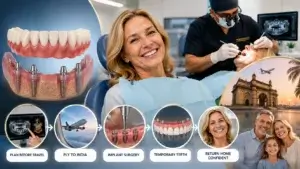
Yes, the treatment can fit one 7 to 14 days India trip in selected cases, but you should plan for the full experience, not just the surgery.
In my experience treating NRI patients, the best results come when we map the case before travel and confirm whether the patient needs a simple full-arch protocol or a more complex staged approach.
A one-trip plan usually works best when:
- The patient has enough bone for immediate implant placement.
- The patient’s medical history is stable.
- The clinic reviews scans before the flight.
- The patient accepts temporary teeth first, then final teeth later if needed.
The most common short-stay option is All-on-4, which means full arch teeth are supported by four implants in one jaw.
It is designed to reduce treatment time, but it is not the right choice for every mouth. If bone is weak or anatomy is difficult, the plan may change.
How the procedure works
- Review OPG or CBCT scans before travel.
- Confirm the plan, usually All-on-4, All-on-6, or another full-arch option.
- Place the implants during the scheduled surgery visit.
- Attach temporary fixed teeth if immediate loading is possible.
- Let the bone heal, then place the final teeth after osseointegration.
What makes one-trip treatment realistic?

The key is sequencing. We first assess the case, then place implants, then provide a temporary fixed prosthesis when possible.
That gives you function and appearance during healing while your implants begin osseointegration, which means the bone starts bonding to the implant surface.
A realistic NRI trip often includes:
- Pre-travel review of OPG or CBCT scans.
- Digital planning and bite analysis.
- Surgical placement of implants.
- Temporary fixed teeth, if the case supports immediate loading.
- Written aftercare and remote follow-up plan.
When one trip is not enough
One trip may not work if you need major bone augmentation, extensive infection control, or complex full mouth reconstruction across both jaws.
- In those cases, the first trip may focus on surgery and temporaries, while the final prosthesis comes later.
- That is often safer than rushing the process.
- Every patient’s dental health is unique.
The information in this guide is educational and does not replace a personalized consultation with a qualified dental professional.
How this treatment usually happens

The treatment path should be planned backward from your travel dates. If you only have 7 to 14 days in India, the clinic must organize the case before you arrive.
That means scan review, medical screening, and prosthetic planning should happen in advance.
A typical short-stay flow looks like this:
- Share your scans and medical history before travel.
- Confirm whether the case suits All-on-4, All-on-6, or another full-arch plan.
- Schedule surgery and prosthetic steps in a tight sequence.
- Give temporary teeth if immediate loading is clinically suitable.
- Set follow-up review dates before you fly back.
Common treatment choices
- All-on-4. Four implants support a full arch of teeth.
- All-on-6. Six implants support a full arch, often used when extra support is needed.
- Bone augmentation. This means building bone where support is weak.
- Zygomatic implants. These longer implants anchor into cheekbone areas in selected complex upper jaw cases.
Full Mouth Dental Implants India cost for NRI
The total cost is usually much lower in India and Ahmedabad than in the USA, UK, or Europe, but the final estimate depends on the implant plan, bone condition, and prosthetic choice.
Vardan Dental Studio notes that implant pricing should be given after scan review, because the doctor needs x-rays before giving a proper quotation.
Typical cost estimate in India and Ahmedabad
- Single implant with crown in India, approx. INR 25,000 to 60,000.
- Full mouth implants for one jaw in Ahmedabad, approx. INR 1,50,000 to 4,50,000.
- Full mouth implants for both jaws in Ahmedabad, approx. INR 3,00,000 to 9,00,000.
- Complex full mouth cases with grafting or special implants can cost more. These are estimate numbers, not fixed prices.
India vs USA, UK, Europe
| Treatment scope | India and Ahmedabad estimate | USA estimate | UK estimate | Europe estimate |
|---|---|---|---|---|
| Single implant with crown | INR 25,000 to 60,000 | USD 3,000 to 5,000 | GBP 2,000 to 3,500 | EUR 2,000 to 4,000 |
| Full mouth, one jaw | INR 1,50,000 to 4,50,000 | USD 18,000 to 30,000 | GBP 12,000 to 25,000 | EUR 12,000 to 22,000 |
| Full mouth, both jaws | INR 3,00,000 to 9,00,000 | USD 30,000 to 60,000 | GBP 25,000 to 45,000 | EUR 25,000 to 50,000 |
These are estimate numbers used for comparison only. The real quote changes with implant brand, number of implants, temporary teeth, final prosthesis, and whether bone grafting or sinus lift is needed.
What changes the cost
- Number of implants.
- One jaw or both jaws.
- Need for grafting or sinus lift.
- Temporary versus final prosthesis.
- Implant brand and lab work.
- Follow-up visits and aftercare support.
Why price alone is not enough
In dental tourism, the lowest price can be a poor filter. You should ask about implant brand, surgery protocol, sterilization standards, and who will manage complications if you return abroad.
A trusted implant clinic in Ahmedabad should answer these questions clearly and without pressure.
Trust checklist for NRIs
Trust matters more than marketing when you are flying in for major dental work. You need a clinic that can plan around your travel, not a clinic that asks you to adjust your life around theirs.
Look for these points:
- Clear pre-travel scan review.
- Doctor-led treatment planning.
- Experience with NRI and dental tourism cases.
- Transparent cost breakdown.
- Written follow-up plan after you leave India.
- Proven implant systems such as Nobel or Straumann, when clinically appropriate.
- Real before and after cases with timelines.
Questions to ask before booking
- Can my case be completed in one trip?
- Do I need temporary teeth or final teeth in the same visit?
- How many follow-up days should I keep in India?
- What if I need bone grafting?
- What support do I get after returning home?
- Who will handle urgent issues if I am abroad?
What builds confidence
For NRIs, confidence usually comes from three things:
- The doctor explains the case clearly.
- The timeline matches the travel window.
- The clinic shows experience with full arch implant treatment.
At Vardan Dental Studio, our approach is built around planning, not guessing.
In over 13,000 implant cases, the most successful outcomes have come from careful diagnosis, not rushed promises.
Step-by-step NRI travel plan

A clean travel plan reduces stress and improves treatment coordination. If you want full mouth implants in one India trip, you should start planning before boarding the flight.
Before you travel
- Share your OPG or CBCT scan.
- Share your medical history.
- Share your current medications.
- Tell the clinic your exact travel dates.
- Confirm whether you need local anesthesia or deeper sedation.
- Ask for a written estimate and timeline.
During your India stay
- Day 1, final consultation and confirmation.
- Day 2, surgery if the case is ready.
- Day 3 to 7, review, healing check, and prosthetic steps.
- Day 7 to 14, temporary teeth or final-stage adjustments, depending on the plan.
After you return home
- Follow the prescribed hygiene routine.
- Attend remote reviews if the clinic offers them.
- Avoid hard chewing on the healing side if advised.
- Keep all scan reports, prescriptions, and implant details.
How to think about healing
Healing matters as much as surgery. Even when implants go in on day one, the bone still needs time to bond with the implant surface.
That bonding phase, called osseointegration, usually guides when the final prosthesis can be placed.
Important healing points:
- Do not rush the bite.
- Follow soft diet advice.
- Keep the surgical area clean.
- Report pain, swelling, or mobility early.
- Follow the implant team’s review schedule.
Why Vardan Dental Studio is best for Dental Tourism
A clinic becomes relevant when it can connect experience, technology, and patient coordination.
Vardan Dental Studio has worked in Ahmedabad since 1997, and its implant-led care is built around advanced planning, clinical experience, and international patient handling.
From my 25+ years of performing implant procedures in Ahmedabad, I know NRI patients usually want three things:
- Less travel waste.
- Clear cost logic.
- A treatment plan they can trust.
Pro tips for NRI patients
If you want the trip to work, keep the plan simple and practical. Small preparation steps save time and reduce surprises.
- Send your scan early, not after booking flights.
- Keep at least a few buffer days in India.
- Ask for temporary and final prosthesis timelines separately.
- Confirm post-op support before paying.
- Choose a clinic that gives you written treatment notes.
- Ask which implant system the doctor plans to use and why.
Common mistakes to avoid
- Booking flights before scan review.
- Choosing only by cheapest quote.
- Assuming every full mouth case can be finished permanently in one visit.
- Ignoring medical issues like diabetes, smoking, or gum disease.
- Leaving India without a clear review plan.
Final decision framework
The best answer is simple. If your bone, health, and travel dates align, full mouth dental implants can often be started and functionally restored in one India trip.
If your case needs grafting or extra healing time, the right plan may still begin in one trip, but the final teeth may need a second visit.
Use this decision filter:
- Can my scan support a short-stay plan?
- Do I understand the full cost, not only the surgery quote?
- Does the clinic give me a written timeline?
- Do I know what happens after I fly home?
- Do I trust the doctor’s experience with NRI cases?
Ready-to-use closing section
Planning a one-trip NRI implant visit starts with scan review, not flight booking.
Send your OPG or CBCT scan, travel dates, and medical history first, then ask for a case-specific treatment plan and cost estimate.
**Vardan Dental Studio, Ahmedabad can help you with this planning.** The clinic is at Hender 17-18-19/A, Vardan Tower, Opp. Pragatinagar Corner, Naranpura, Ahmedabad, and the contact number listed on the website is 079 2743 0405.
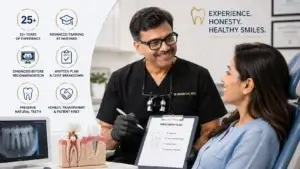
Reviewed by Dr. Brijesh Anil Patel, BDS, MDS. He has 25+ years of clinical experience, 13,000+ implant procedures, Harvard School of Dental Medicine training, and founded Vardan Dental Studio, Ahmedabad.
FAQ
1) Can full mouth dental implants really be done in one India trip?
Yes, many cases can start and functionally finish in one trip if the bone is suitable and the case is planned in advance. Some patients still need a second visit for the final prosthesis after healing.
2) How long should I stay in India for full mouth implants?
A short-stay plan often needs about 7 to 14 days, but the exact duration depends on the number of arches treated, healing needs, and whether temporary teeth can be placed immediately.
3) Is All-on-4 the same as full mouth implants?
No. All-on-4 is one type of full arch solution that uses four implants to support a full set of teeth in a jaw. It is often used because it can reduce treatment time, but it is not suitable for every patient.
4) What should I check before choosing a clinic in India?
Check scan review, doctor experience, implant brand, sterilization standards, total cost breakdown, and post-op support after you return home. A good clinic should explain all of this clearly before you travel.
5) Is getting implants in India safe for NRIs?
It can be safe when you choose an experienced clinic, share your medical details early, and follow a proper treatment plan. Safety depends on diagnosis, planning, surgical skill, and aftercare, not on price alone.